The Canadian Long Branch No.4 "Jungle Carbine"
experimental prototype
Please be aware that some specialist imagery may take time to load.
This site is for dedicated researchers and is best viewed on desk or laptop.
See also: ......BSA Lee-Enfield No.5 trials rifle in .22RF ...... - ......Fazakerly Experimental No.5 in .22RF
or the Lee-Enfield No.5 Rifle in 7.62mm calibre and the Australian "Jungle Carbine" No.6 Rifle
plus the Experimental Shortened SMLE in .22RF
This is one of what were believed to be a small number of lightened carbines built up at the Canadian Long Branch factory in 1943 on their Lee-Enfield No.4 Mk.I action.
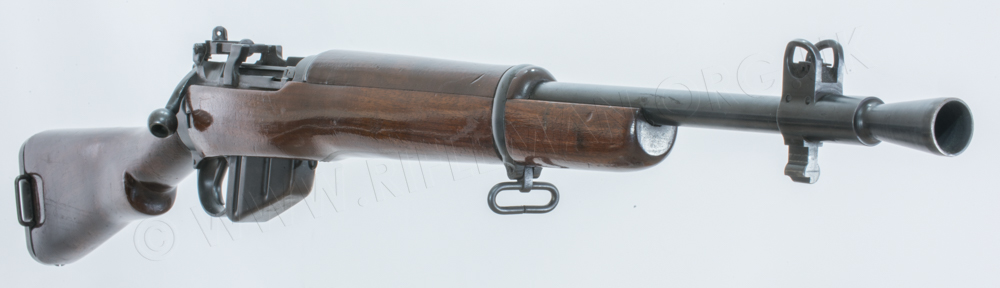
This carbine was presumed to be a follow-on experimental prototype from the also 1943 designed Canadian No.6 Shortened and Lightened Rifle, which utilised a one-piece three-quarter-length stock that was deemed, during trials, to be susceptible to breakage.
Hover over or Click image to bring up hi-res file and magnifier
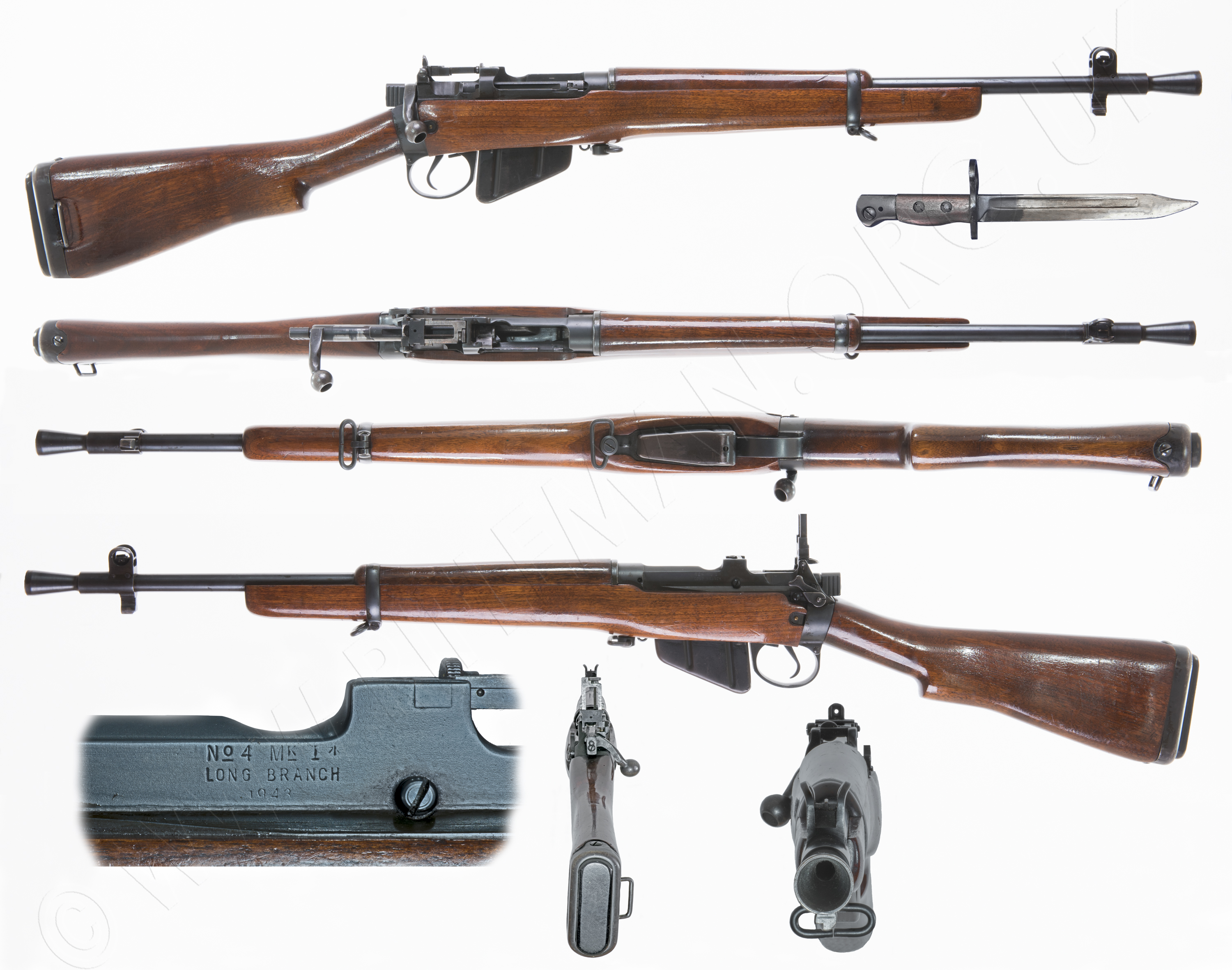
Sold at a Bonhams auction in 1999 as Lot No.35, the carbine was listed as being one of only three prototypes believed to have been built up. This was noted by Ian Skennerton in his reference book for the Lee-Enfield Rifle.
This is a text-searchable single page document.
It may take a few moments to load.
Double tap tablet or click  for full page display.
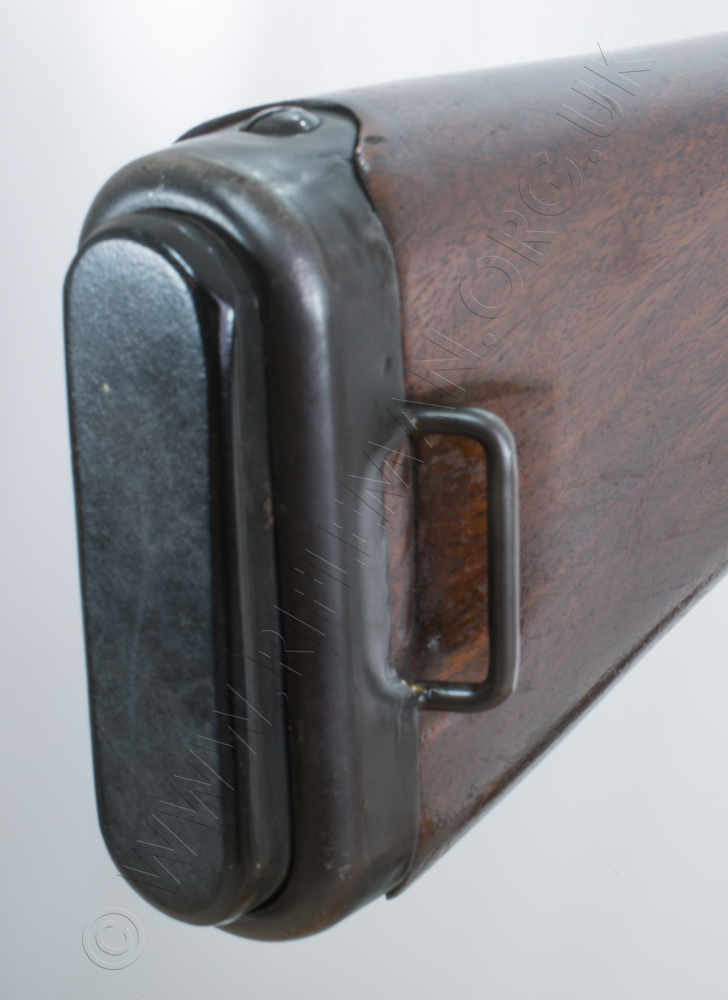
One of the few differences that has been noticed between these carbines and the Enfield No.5 Mk.I is the slightly greater depth of the rubber recoil pad.
More significant is the short and deeply tapered cut-out in the butt-stock for the lead-in of the webbing sling to the sling-loop integral with the steel cap of the butt-plate.
The chamfered lightening cut at the rear of the receiver side wall just ahead of the rear-sight differs slightly from the issue No.5, noticeable because of the absence of the latter rifle's spring-loaded bolt-head-lug lifting pressel for bolt removal; the Canadian rifles having a slot near the front of the receiver' side-rail via which the lug is is raised prior to withdrawal of the bolt.
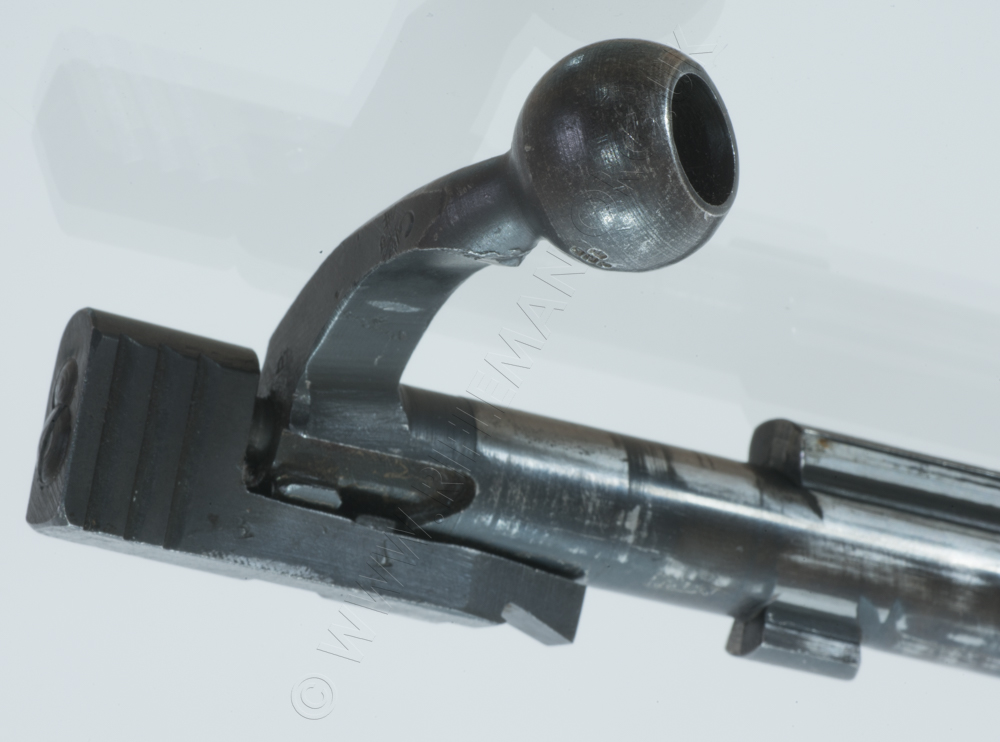
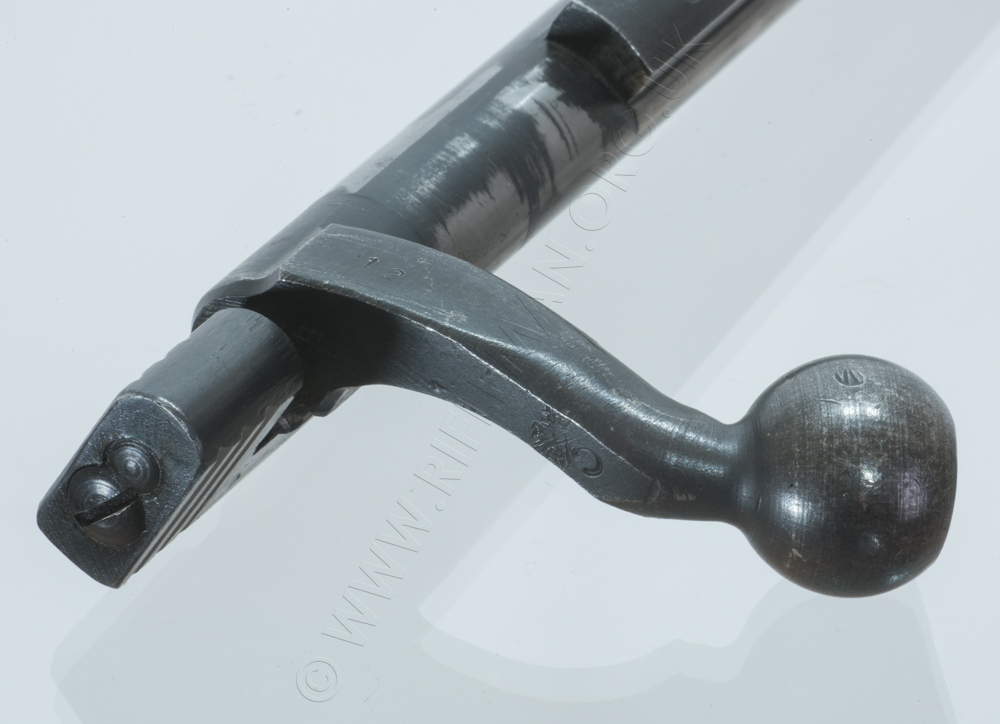
The forward bending of the bolt handle's knob is another definite feature.
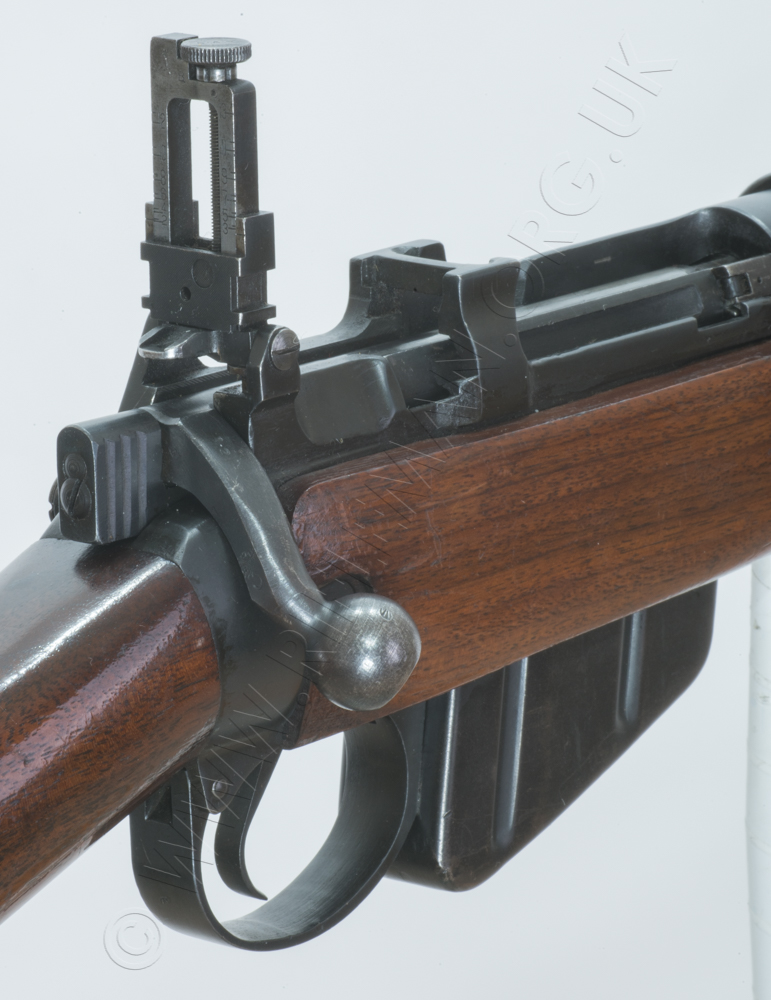
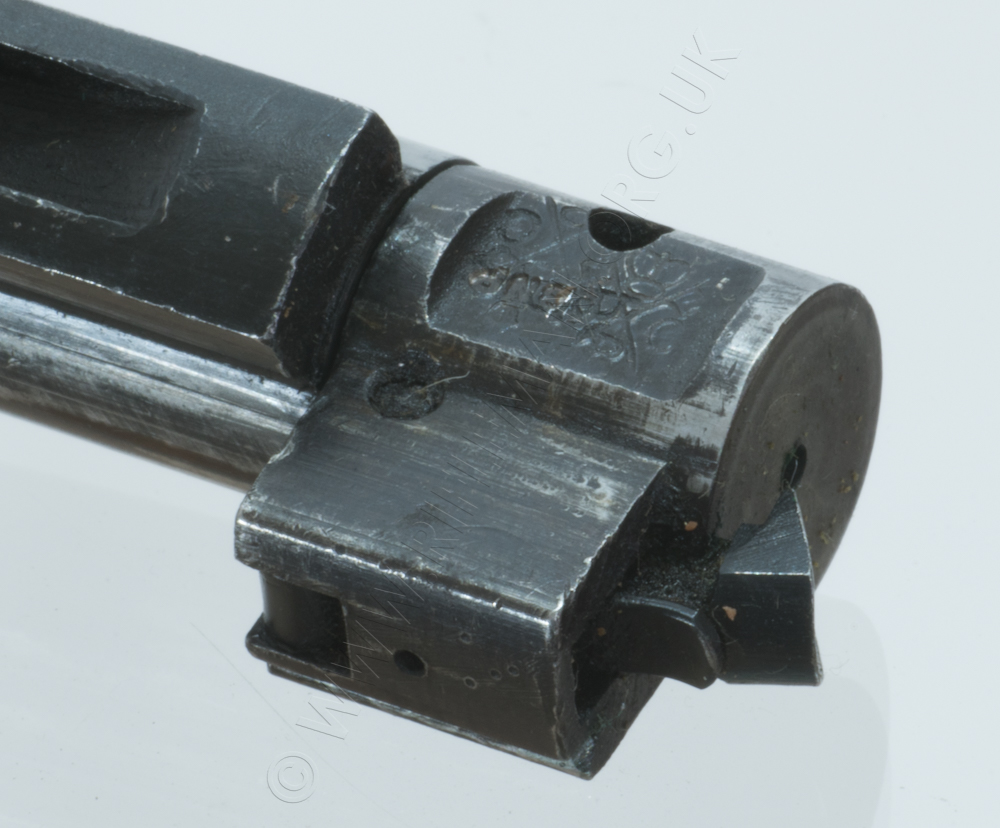
The Long Branch bolt-head.
And further detail of the forward bend of the bolt handle knob.
The usual bored hole in the knob to lighten the bolt body is shown clearly
 .......
The existence of Canadian prototyping of a lightened version of the "Jungle Carbine" from their No.4 Mk1* rifle has been fairly contentious in the past, but the presence of an example in the Canadian War Museum collection in Ontario has confirmed that this occurred. Estimates of the numbers produced vary from three to 10, 20 and up to 30. One example,very similar to the rifle on this page, that came to the attention of the members of the Milsurps forum in 2011, excited comment and opinion through to 2012. The fine condition of the furniture drew opinion that any 70 year old weapon which had seen significant use in trials, or endured ongoing testing, would not have the excellent finish that still remained - as is indeed the case with the carbine illustrated on this page, which has a remarkably good finish to the furniture. Other opinion suggested that many rare protoypes were generally kept clear of any heavy usage, and were usually retained in collections as reference pieces. It is also known that arsenal tool-rooms were often required to assemble 'one-offs' or small numbers of weapons to assess the practicality of manufacturing processes and use of exisiting components. Such weapons barely saw the light of day outside the factory. Trials rifles were rarely produced in numbers of less than a hundred for initial assessment and, if deemed a reasonable proposition, then further trialled occasionally in thousands.
This tool-room and prototyping theory is certainly borne out by our experience in handling and inspecting rare Lee-Enfield protoypes and trials rifles over many years: in fact even those rifles that were known to have been issued for various limited trials, been carefully used, returned to stores or factory collections and subsequently sold out of 'service', are often still in particularly fine condition, and retain their special factory finish that was far better than any subsequent production arms enjoyed.
Peter Laidler, author of several reference books on British small arms, and who for many years looked after the Small Arms School Collection at Warminster, wrote on the Milsurps thread discussing this lightened rifle that .....
"If you look at every edition of Small Arms of the World from 1961 onwards (I've just checked in our technical library.......), there, for all to see is a right hand side view Mk1* variation of the No5 AND it is identified as such AND a No5Mk1* is identified as a minor variant. If you're inclined to copy and enlarge the picture to verify what you're seeing, then don't concentrate on the slot, but the lack of bolt head catch."
The point made was that the illustrated carbine was evidently of Canadian manufacture, but described as a No.5 Mk.1 of Enfield origin; perhaps because one of the latter was not readily available at the time the photographs were taken.
Always up to a challenge, we have done just what was suggested; additionally including the photograph shown by Ian Skennerton on page 320 of his fine reference tome "The Lee-Enfield", along with the disassembly image on the following page 322. In his text on the previous page 319, Skennerton wrote that .....
"At least one prototype .303 No.5 jungle carbine was produced at the Long Branch factory, the illustrated specimen is from the Canadian War Museum collection. This example utilised a No.4 Mk.I* receiver with No.5 type barrel, flash eliminator assembly and fore-end. The backsight is the Mark 3 of a No.4 rifle, re-graduated to 800 yds, which makes it similar to the British-made No.5 Mk.2 sight." (See our comparison of the No.4 and No.5 rifles' rear sights)
It is certainly worthy of note that the photographs in the various editions of W.H.B. Smith's "Small Arms of the World", and Skennerton's book, are each immediately adjacent to the photos of other Canadian specials, including the one-piece stocked Lightened Rifle No.4 prototype shown below by courtesy of the Warminster Small Arms School Collection.

The above rifle became known for breakages of its rather slender wrist, and that design went no further because of this, and a decision that the rifle was also overlong.
As well as one of the above rifles, and another example of our subject Long Branch No.4 based Jungle Carbine, the Canadian War Museum holds what may be considered to be an intermediate prototype. This is also a shortened and lightened model, but possibly the first of these experimental rifles to be fitted with a flash eliminator.
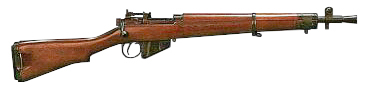
It certainly appears to be a half-way house betwixt the one-piece stocked prototype and the full "Jungle Carbine" example that is the subject of this page.
Below is our zoomable image of a Fazakerly made standard issue No.5 Mk.I atop the Canadian 'prototype', with the photographs from Smith's "Small Arms of the World" beneath, and the carbine and a disasssembled example from "The Lee-Enfield" at the bottom.
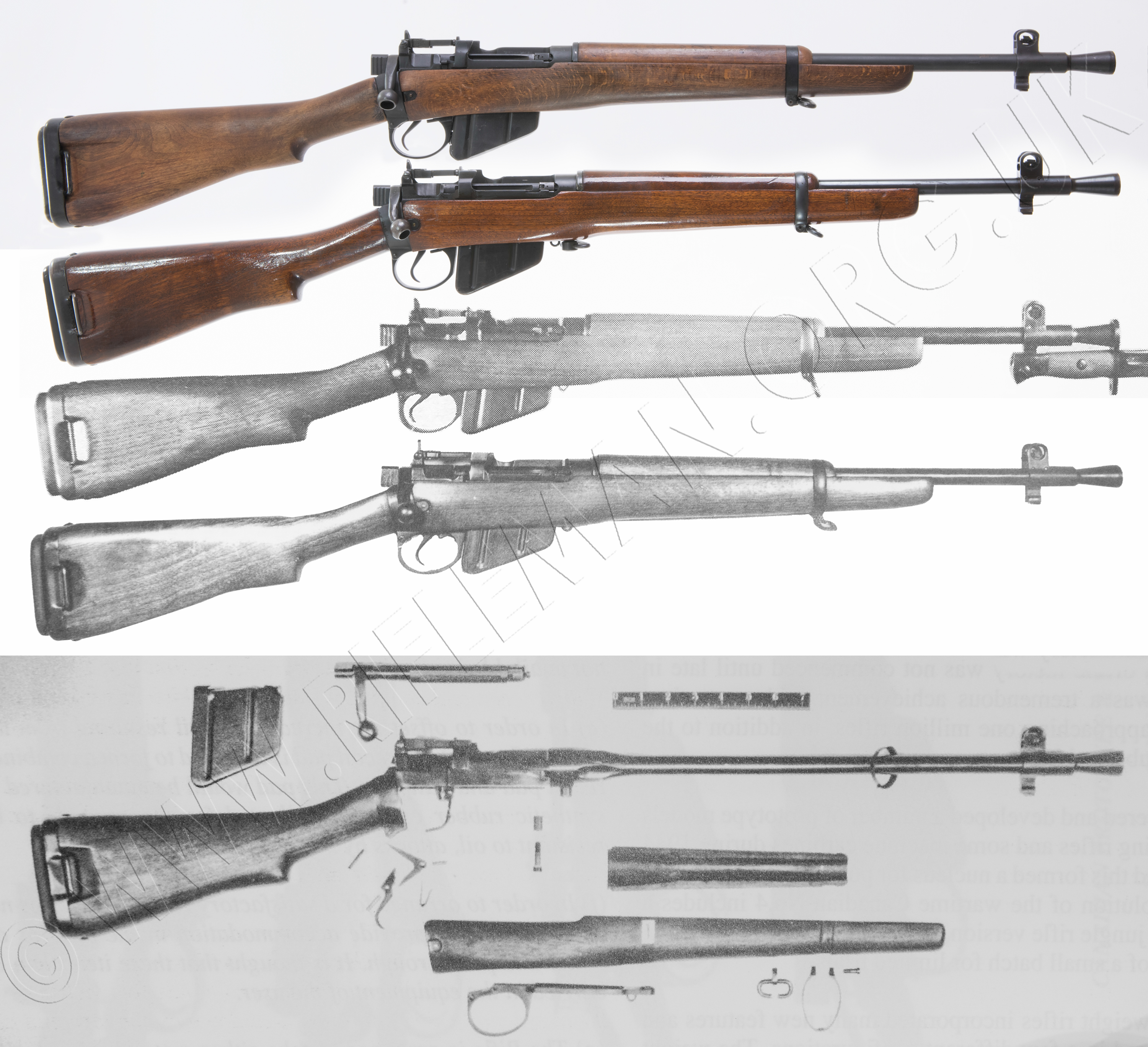
From Top to Bottom
1: Fazakerly issue No.5 Mk.I
2: Canadian No.4 Mk.I* subject lightened rifle
3: "Small Arms of the World" photo - captioned No.5 Mk.1
4: "The Lee-Enfield" photo - captioned "Prototype .303 No.5 Rifle (Canadian War Museum)".
5: "The Lee-Enfield" photo - captioned on Aberdeen Proving Ground* film negative No. A1646 as "Enfield Rifle, Cal .303, No.5".
The images of the half-tone photographs are obviously not as defined as would be ideal, but some aspects are still evident.
Rifle number three, as Peter Laidler reported, appears not to have the sprung release catch behind the charger bridge for lifting the Enfield bolt-head lug, and appears to have the slot in the forward end of the receiver side rail for the bolt-head lug to be introduced and/or lifted clear for bolt removal - as on the Long Branch production.
Rifle number four certainly does not have the sprung release catch behind the charger bridge, and shows the slot in the forward end of the receiver side rail - as on the Long Branch production.
The photo of the disassembled rifle number five shows the bolt with a forward bent handle and the barrel reinforce lightening cuts, which warrant comparison with the Enfield ones. The fore-end also has the slightly flattened nose previously mentioned, and present on each of the 'prototypes', except perhaps number four.
That the latter three photographs may each have been taken in the same place, and at the same time, cannot be dismissed.
All the above carbines, except the Fazakerly issue example, show the fractionally more prominent rubber recoil pad reported elsewhere. Additionally, the 'prototypes' each use a fully machined barrel-band with a radiussed outer periphery, whereas the issue rifles have flat pressed-steel bands. Furthermore, the chamfering of the right-hand-side of the butt from the recoil-pad-cap to accommodate the webbing sling is wider on the No.5 Mk.I, and the machined taper runs much further forward than on the 'prototypes'. Yet another point is that each of the 'prototypes' still has the chain-loop at the front of their No.4 Mk.I trigger guard/magazine-well component. This was dispensed with on the issued No.5 rifles.
We do not think it an optical illusion, but it could reflect the varied angles at which the photographs may have been taken, that the wrists of the prototypes appear to be slightly longer than the Fazakerly No.5. The images of the Fazakerly No.5 and 'our' No 4 Mk.I* conversion were taken from precisely the same position in our studio.
Our own example was stripped to determine relevant points of difference from an issue rifle.
Below: the receiver body and barrel reinforce showing its four scalloped lightening cuts, the chamfered cut to the rear left of the receiver side ahead of the safety catch, and the cut in the bottom of the butt-socket where the rear of the trigger-guard fits. This latter cut would have made the fitment of the Mk.2 trigger arrangement to the butt-socket impractical, so the trigger had to remain mounted on the trigger-guard and separate from the action - still susceptible to any movement of the fore-end wood.
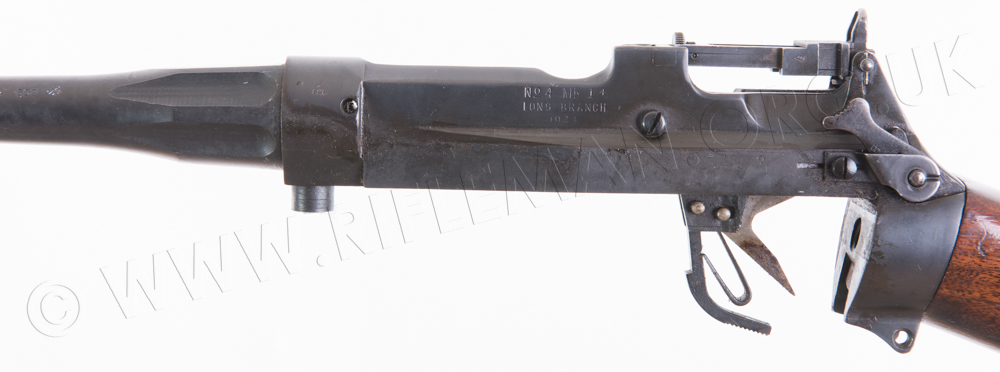
Our zoomable representation of the Aberdeen Proving Ground* image.
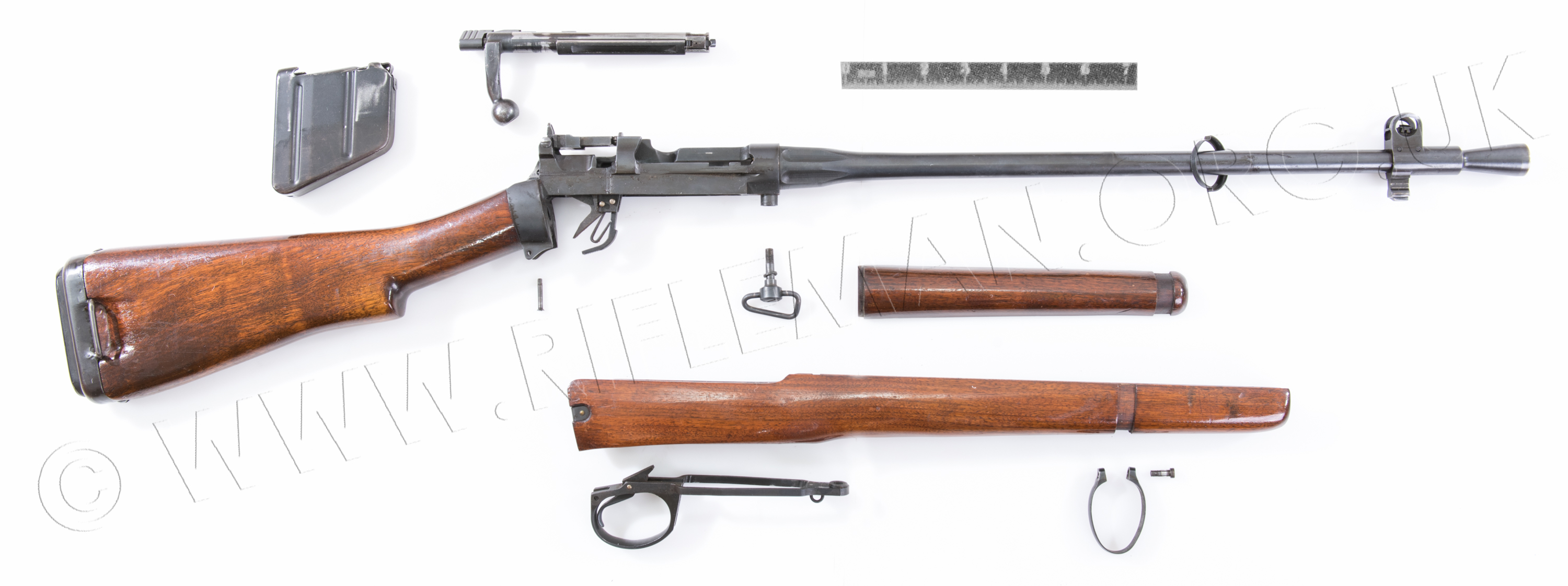
The only significant difference between the CWM example and this page's subject carbine is that the rear-sight leaf, still a Long Branch component, remains calibrated to 1300 yards. Apart from a few small components being marked as "LB", there are no other identifying stamps on the rifle whatsoever; indeed there is no serial number such as is carried on the CWM carbine. Only the usual receiver side marks for the No.4 Mk.I and the 1943 date give the definite link to the carbine's presumed origin.
One other rather less important difference is the Bonhams carbine being fitted with the trigger-guard sniper/target shooting sling swivel in front of the magazine. This component is unmarked, and neither of Parker-Hale nor Enfield manufacture.
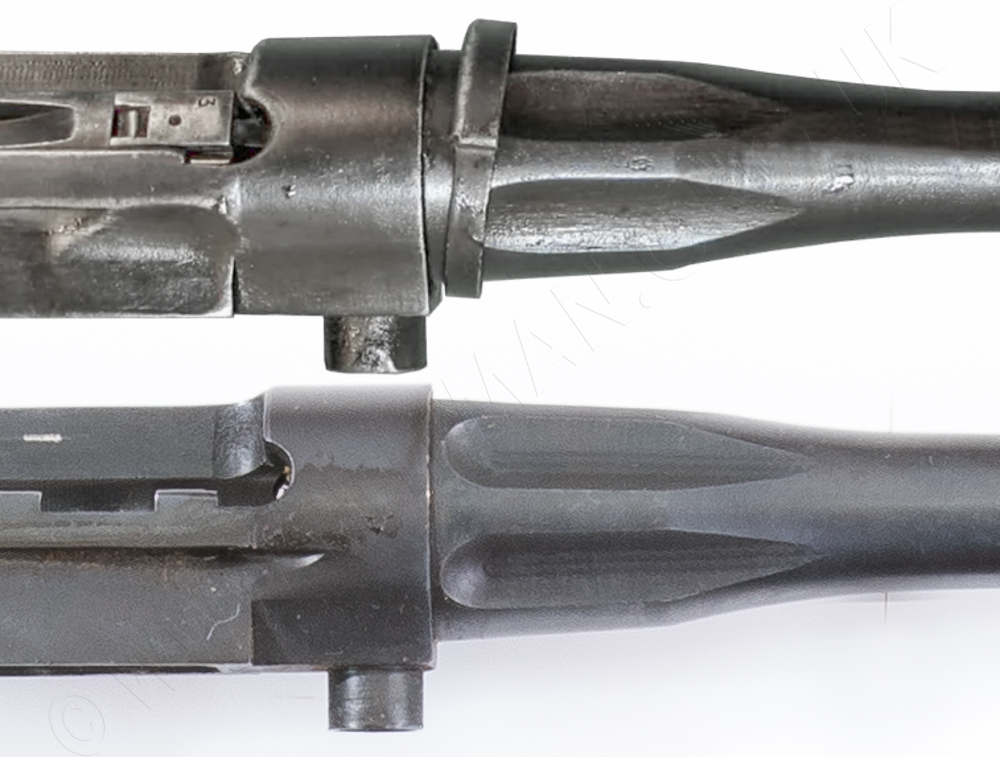
The note in the Bonhams catalogue stating that the Long Branch prototype's scalloped lightening cuts to the barrel's reinforce differed from those of the Enfield No.5 Mk.I rifle is confirmed by our image comparing the two further down this page.
The issue No.5 is top, and the Long Branch prototype underneath.
The latter has the rear of the scallop machined to a radius that is different at its rearward end, and appears deeper, being machined closer to the receiver ring.
The difference between the Enfield and Long Branch system of raising the bolt-head lug for bolt withdrawal can be seen where the slot is cut out of the forward end of the receiver side rail in the lower image. The bolt-head is only present in the upper photograph.
_____________________________
* The Aberdeen Proving Ground is to this day a testing facility in Hartford County, Maryland, U.S.A.
The significance of this is that presumably at least one of the Long Branch lightened No.5 rifle equivalents found its way to the United States for assessment. The photographs are dated as having been taken there on 20th. March 1944, early in the year after these "No.5" prototypes' receivers were built at Toronto.
The first image of three Canadian rifles shown on page 322 of Skennerton's "The Lee-Enfield" include a supposed standard issue Enfield No.5 Mk.I 'Jungle Carbine', along with the one-piece stocked Lightened Rifle No.4 prototype, and a 'standard isssue' No.4 Mk.1; although the latter rifle carries a round-buttoned cocking piece. The photograph is entitled ...
RC project 3659 (959-SM3-134). Comparison of lightened rifles with standard weapon. (1) Enfield Rifle, Cal. .303, No.5. (2) S.A.L Lightened Rifle, Cal. .303 (3) Enfield Rifle, Cal. .303, No.4 Mk.I.
The photograph of the disassembled rifles includes the one-piece stocked Lightened Rifle No.4 prototype, and is entitled thus ...
RC project 3659 (959-SM3-134). Comparison of lightened rifles with standard weapon. (1) Enfield Rifle, Cal. .303, No.5. (2) S.A.L Lightened Rifle, Cal. .303 (Note different trigger mechanisms, stocks and barrel lightening cuts.
It is apparent that the "standard" No.5 rifle in each photograph is in fact one of the Long Branch prototypes, with the forward-bent bolt-handle-knob and the steeply chamfered lead for a sling to the sling-loop in the butt-stock. The slightly flattened nose of the fore-end is also evident.
The reference to the S.A.L. Lightened Rifle refers to Small Arms Limited, the Crown corporation instituted at the time of Canada's involvement in the Second World War in 1939. The factories were set up in Toronto, leading to the development of the Long Branch manufactory.
In 2014 Roger V. Lucy wrote an article entitled "Small Arms Ltd.'s Experimental Firearms"
"Advised of an Indian requirement for 25,000 rifles, with specifications similar to its lightweight rifle, SAL undertook a redesign, incorporating some of the features of the British No.5. The prototype was completed in April 1944, but India adopted the No.5 rifle, which was now in production. Australia also trialed the first pattern Canadian lightweight rifle in August 1944. The Australians were impressed by the SAL rifle’s accuracy, handling and serviceability but deemed its excessive flash unacceptable. They also found it too light – particularly in the butt portion – for Australian methods of close-in fighting. In December 1944, SAL decided to halt further development. The lightweight rifle project was declared completed by the ATDB on 5 January, 1945."
This extract contains one of the few references to the fact that work was undertaken at Long Branch to prototype an equivalent to the British standard issue rifle No.5 Mk.I.
The pages here mentioned in Ian Skennerton's "The Lee-Enfield", the later edition published in 2007, include comprehensive information on matters relating to Canadian rifle production.
See also: ......BSA Lee-Enfield No.5 trials rifle in .22RF ...... - ......Fazakerly Experimental No.5 in .22RF
or the Lee-Enfield No.5 Rifle in 7.62mm calibre and the Australian "Jungle Carbine" No.6 Rifle
plus the Experimental Shortened SMLE in .22RF
Return to: TOP of PAGE
See this website's Raison d'être